
No translator: I speak German (native), English (fluent) and French (conversational) ·
MSc Cognitive Neuroscience (UAB) ·
AyaSafety training — ICEERS ·
Direct training with the Huni Kuin people in the Brazilian Amazon ·
Personal attention at every ceremony (max. 9 people) ·
★ 5.0 on Google (30 reviews) ·
Weekend retreat in the Sierra de Madrid: €450 ·
One-day ceremony in Madrid: €150 ·
Next weekend retreat: February 2027 (dates to be confirmed) ·
Next one-day ceremony: 12 December (Madrid)
You’ve been turning this over for months — maybe years. Something in you knows there’s a deeper level you’re not reaching. You’ve tried therapy, meditation, big changes in your life. And here you are, looking for something you can’t quite name yet.
What you’re feeling is real. And it deserves to be taken seriously.
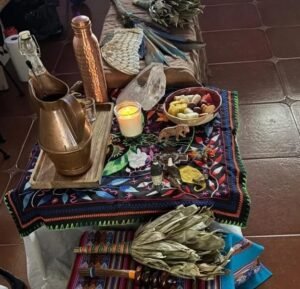
People come to this from different places. Some have a life with nothing really wrong in it — work, a partner, children, everything more or less in place — and can’t shake the feeling of watching their own life from the outside, as if it were happening to someone else.
Some have no problem to solve. They have everything they need to be happy, and mostly they are. And yet the sense that this can’t be all there is never quite goes away.
Some don’t really know what they want. They only know they’ve been putting off the question of what they’re doing with their life for far too long.
And some, deep down, come because of someone else: a mother, a partner, a child — something left unfinished with someone, that they haven’t found any other way to reach.
Everyone comes looking for something different. What they find is sometimes surprisingly similar:
The pattern you keep repeating, finally in view. That reaction you’ve been having for years — with your partner, at work, with yourself — stops being “that’s just who I am” and becomes something you can look at. And what you can look at, you can start to change.
What you understood in your head, you now feel. You’ve known exactly what’s going on with you for a long time. Knowing hasn’t changed anything. Some nights, it stops being an explanation and becomes something you feel inside.
Someone, without all the history. Your mother, your partner, someone who is no longer here. For a while, everything that has built up between you falls away, and you see that person as they really are.
This doesn’t always happen. Not to everyone, and not necessarily on the first night. Further down I describe both sides, including the difficult nights. But this is what makes it worth preparing well.
Why we do this
This happens to me a lot on screening calls: someone describes what they’re looking for — more clarity, a way out of a cycle that keeps repeating, meaning after a loss, reconnecting with something they feel they’ve lost — and I think: this is exactly what the medicine can touch.
Not always. Not by magic. Not without work. But it can.
What drives me to facilitate isn’t some grand spiritual story. It’s simpler than that: I’ve seen what can happen when someone sits with the medicine in genuinely safe conditions, with real support to integrate what comes up. I’ve seen people change profoundly, and I’ve been through some of those changes myself.
Further down I describe in detail what really happens during a night, including what doesn’t go well. If you want to go straight there: What to expect →
At Alma Fénix, I bring my training in neuroscience, the safety screening and my experience with Amazonian traditions. A female co-facilitator is with me at every ceremony: we never facilitate without one. We hold Ayahuasca ceremonies and retreats in and around Madrid. That means personal attention throughout the ceremony (never more than 9 people), thorough safety screening, follow-up afterwards, and the same facilitator from your first call to your last integration session. We’re not a ceremony service: we’re with you before, during and after, so that what comes up in the ceremony can land in your real life.
- ✓ Thorough safety screening — including medication and mental health
- ✓ Personal attention throughout the ceremony: we come round the room, ask how you are and whether you need anything (groups of max. 9)
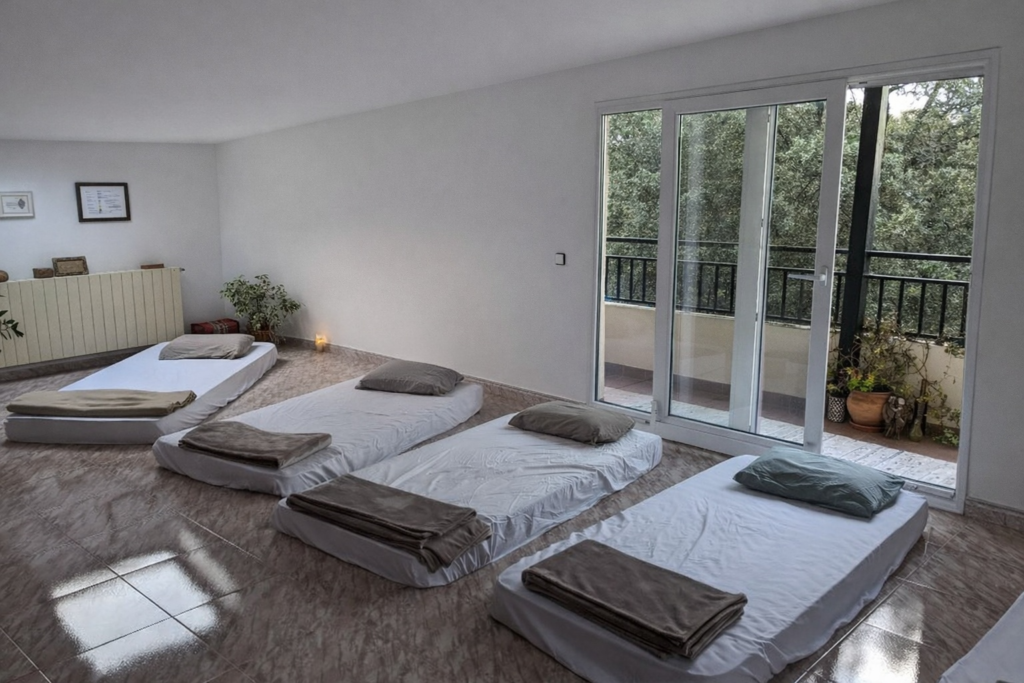
- ✓ Weekend retreat in the Sierra de Madrid, about an hour from the city, with two ceremonies — or a one-day ceremony in central Madrid, near Atocha (10:30 to 19:30, no overnight stay)
- ✓ Follow-up afterwards: the 30-day Alma Fénix Integration Programme (3 structured sessions), included in the weekend retreat; daily messages for the week after a one-day ceremony
- ✓ The same facilitator throughout — screening, ceremony, integration
- ✓ No translator in between: I do your screening call, lead the ceremony and run your integration sessions myself, in English, German or French (integration by video call once you’re home)
- ✓ Weekend retreat: €450, all inclusive · One-day ceremony: €150
What people say
All my Google reviews so far are in Spanish. These are my own translations; you can read the originals on Google.
It was my first time… and I felt really cared for, looked after the whole time, with them always paying attention to me. Very well-trained people. Committed to what they do, giving love and understanding and supporting you at every moment. I recommend it. Thank you so much for everything… The place is spectacular, ideal for these ceremonies.
I spoke with Fede last week. I was hoping to go on an Ayahuasca retreat. Fede was very kind and empathetic. He made a full assessment of my situation and medication. He was honest, as he felt the retreat wasn’t the most suitable option for me for now. He suggested alternatives that I’m considering. Thank you so much for your honesty and advice. It says a lot about the value of what you do.
A hard, healing and beautiful experience. Grateful for the support before, during and after the session from Fede and his team.
⭐ 30 reviews · 5 out of 5 on Google — 👉 See all reviews →
Who you’ll be with
There’s no big team or organisation behind this. I’m the one who talks to you on the first call, who is in the room during the ceremonies — always alongside a co-facilitator — and who accompanies you through integration. It’s a small project, and that, together with groups of nine at most, is what lets me get to know each person before they arrive: I know what they’re bringing, what worries them and what they need, so I don’t have to find out at three in the morning.
Fede Funkel
I came to plant medicine in 2008, during a year travelling through Latin America. It wasn’t planned. Some Colombians I met in Medellín invited me to look for mushrooms in the forests near Popayán. I went out of curiosity, and what I found was one of the most profound experiences of connection I’ve ever had. Ayahuasca came a few years later.
What followed were years of genuine searching — not as a spiritual tourist, but as someone trying to understand what was happening. I studied cognitive neuroscience because I wanted to understand the mechanism. I learned from the Shuar in Ecuador and the Huni Kuin in Brazil because I wanted to understand the context. And I took part in more than 100 ceremonies before facilitating my first, because I wanted to know from the inside what it means to sit with the medicine.
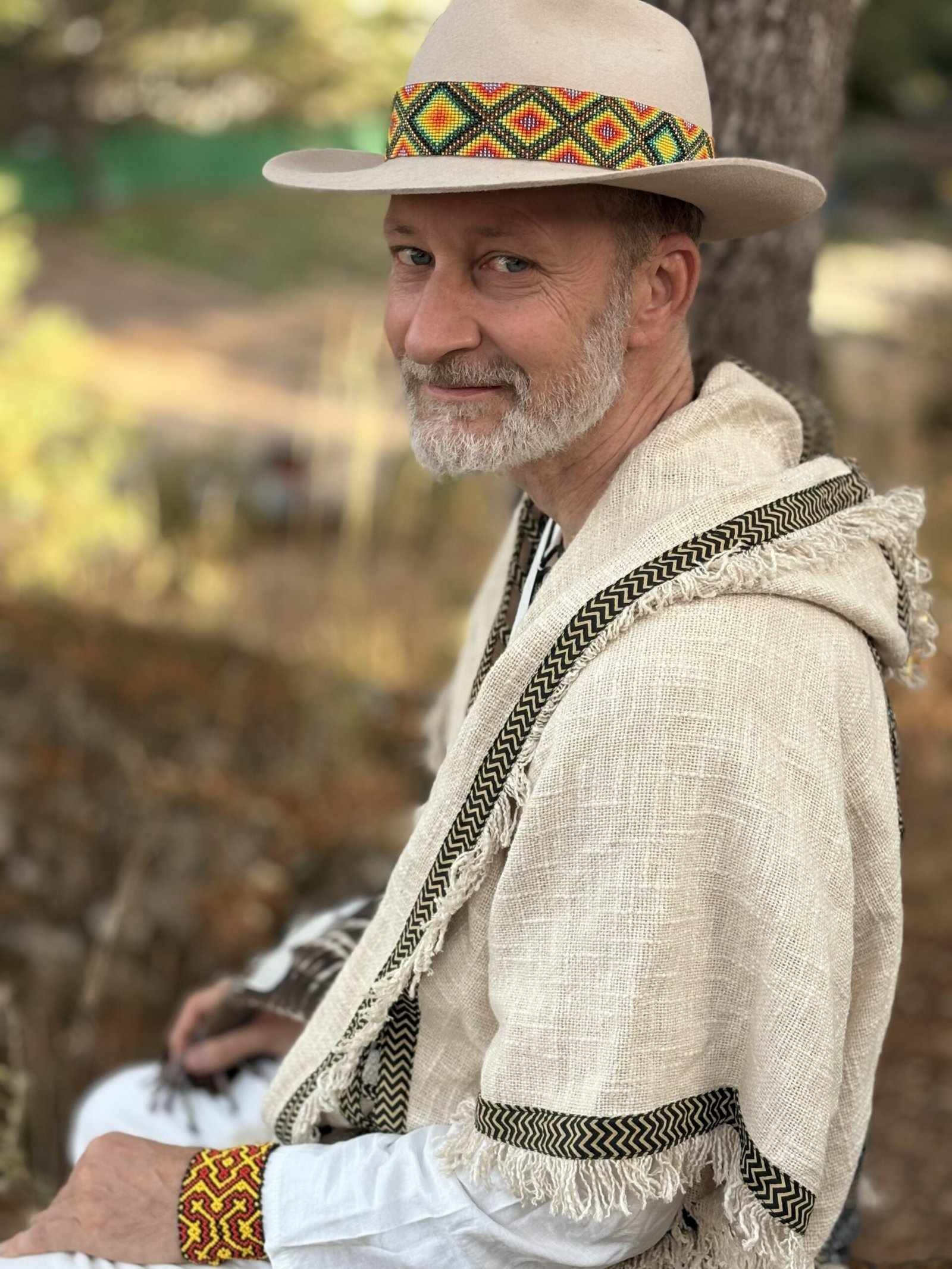
One important thing: I’m not a healer, and I don’t present myself as one. I’m an educator, researcher and facilitator: neuroscience on one side, years of apprenticeship in Amazonian traditions on the other.
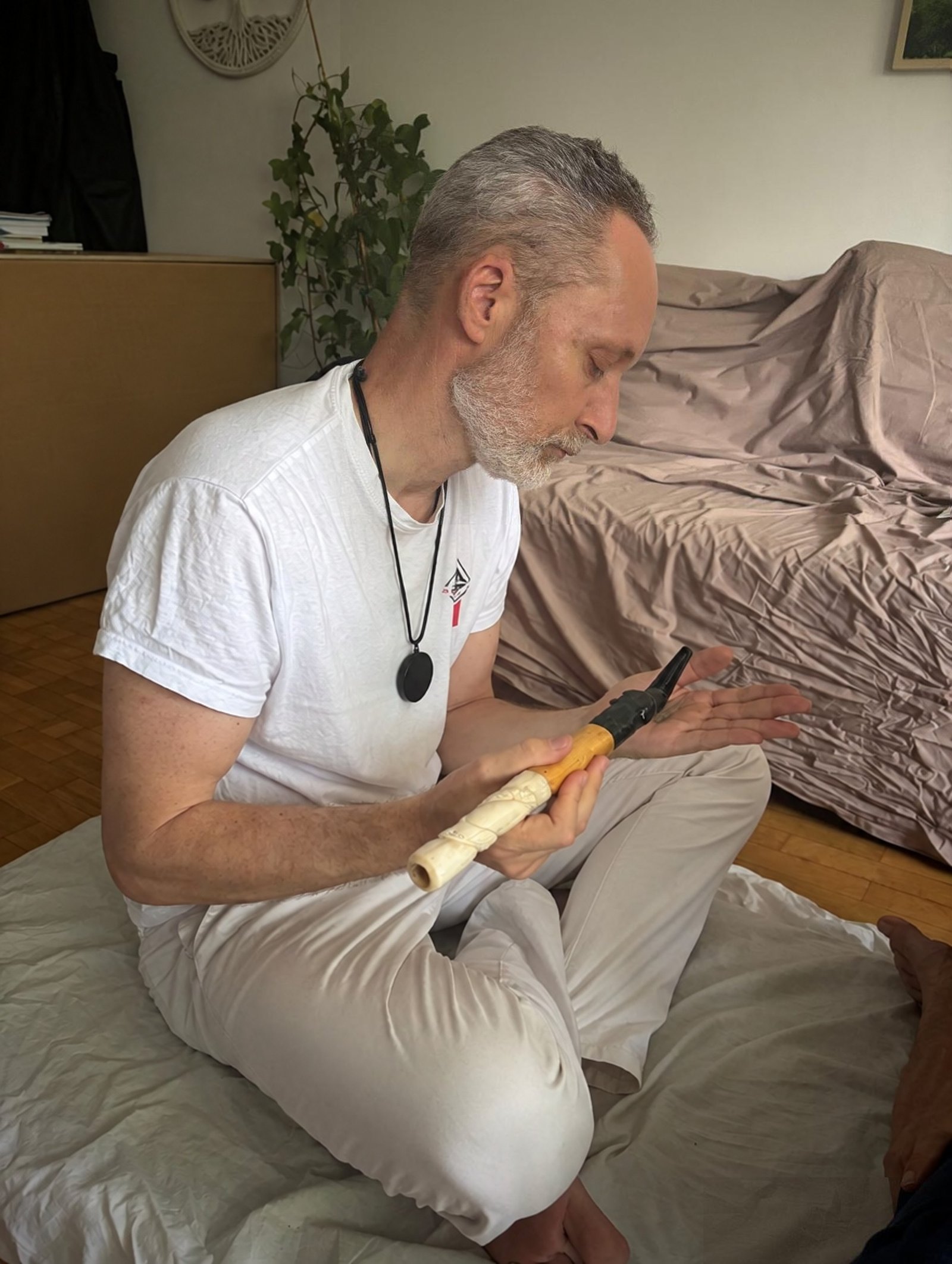
Verifiable training:
MSc Cognitive Neuroscience — Universitat Autònoma de Barcelona ·
MSc Applied Positive Psychology — Universitat Jaume I ·
MSc Transpersonal Therapy — Instituto Marly Kuenerz (in progress) ·
AyaSafety training — ICEERS ·
First aid certificate — Spanish Red Cross ·
Mental Health First Aid — MHFA ·
Psychedelic crisis support — Eclipse ·
Training in Psychedelic-Assisted Therapy — Asociación Psicodélica de Argentina ·
Traditional apprenticeship with the Huni Kuin (Brazil) and the Shuar (Ecuador) ·
Member of the Plantaforma para la Defensa de la Ayahuasca (Spanish association for the defence of Ayahuasca)
From the very beginning, I’ve always facilitated with a partner. I currently work with several co-facilitators, and we never hold a ceremony without one of them present: that’s not a matter of circumstance, it’s a principle of how we work. One of them works with me at each ceremony or retreat, and it’s the same person from start to finish.
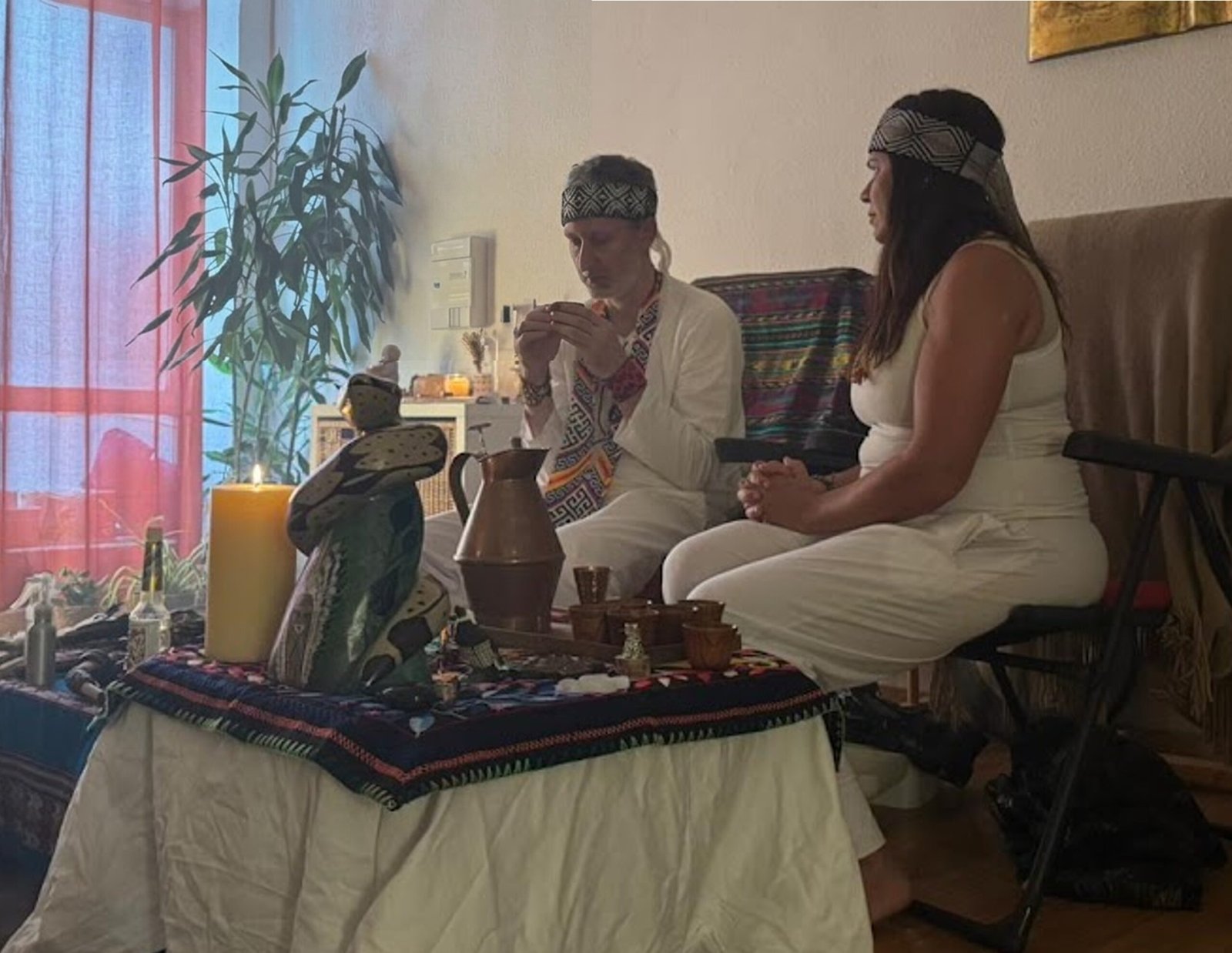
A co-facilitator brings something to ceremonies that I can’t offer alone: another way of seeing, another sensitivity, another way of holding the energy of the room. Two attentive people see more than one, each picks up on different things, and together we can hold the space more fully and more safely.
During the ceremony, we both go round the room and ask each person how they are, whether they need help, and whether the medicine is working for them or they’d like more. We sit beside you if things get difficult, walk you to the bathroom, and support you when support is needed. And for many women who come alone, it makes a real difference to know that if they need help in a vulnerable moment, there will be another woman in the room.
About language: my co-facilitators speak Spanish and basic English. I do the screening, lead the ceremony and run the integration sessions myself, with no translator in between. I explain why that matters for your safety in the Safety section.
Why tradition, and not just protocol
Science keeps you safe. Tradition gives you depth.
You can run an Ayahuasca session in a purely clinical way: substance, dose, room, supervision. It works up to a point. But there’s a part of the work that doesn’t appear in any protocol, and it’s exactly the part the Amazonian traditions have been developing for centuries.
Ritual marks the passage from one state to another. Preparing the space, the smoke cleansing, the way the night is opened and closed. It isn’t decoration. It turns the night from “taking something and seeing what happens” into crossing a threshold, with a clear beginning and a clear end. That boundary helps you let go. And above all, it helps you come back.
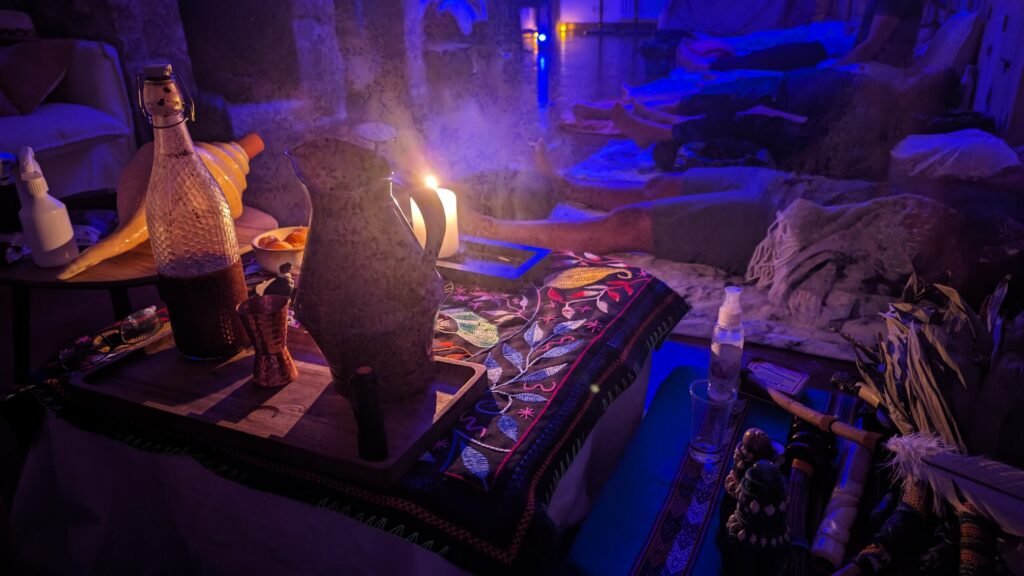
In the traditions I’ve learned from, Ayahuasca isn’t just a substance with effects: she is someone you build a relationship with. She is treated with respect, sung to, and approached with preparation. And much of the work of whoever holds the ceremony is tending to the energy in the room: noticing when it’s rising too much, when someone is getting stuck, when to hold and when to ease off. Music is one of the tools for this (in my ceremonies it’s recorded music), but it isn’t the centre of the night.
I know this will land differently depending on where you’re coming from. If you’d rather translate it into language that feels more familiar, go ahead: call it set and setting, call it group regulation, call it presence. I won’t argue about words. What I will tell you is that this work exists, that you can tell when it’s there and when it’s missing, and that it can’t be learned from a book.
Knowing how to bring someone back. Sometimes a person gets frightened, gets stuck going round in circles, or gets lost. The traditions have generations of experience with exactly that: how to accompany someone who is lost, how to bring the intensity down, how to return someone to their body and to the room. It’s the least glamorous part of all this, and the one that matters most at three in the morning.
And what comes up isn’t a symptom. In a clinical frame, whatever arises gets classified and managed. Here you’re not a patient: you’re a person doing something very old, inside a framework that has been holding experiences like yours for generations. That matters more than it seems. Without a framework to hold it, an experience like this gradually becomes “that strange night” and fades. Inside a tradition, it becomes part of something coherent, and that lasts.
How the retreat works
The ceremony matters. But it’s only 20% of the work. The other 80% happens before and after.
Phase 1: Preparation (2–3 weeks before)
It all starts with a free 30-minute video call. It’s a conversation to see whether it makes sense to go ahead. I ask about your motivation, your physical and mental health and any medication you take, and I explain exactly how the process works. If I see on that call that this isn’t the right moment for you — because of contraindications, your emotional state, or anything else — I’ll tell you clearly. I’d rather leave a place empty than take someone into an experience they’re not ready for. The call is also for you to get to know me and see whether you feel comfortable with me.
If we go ahead, I send you a detailed medical questionnaire: medical and mental-health history, current medication and family history. I review it personally against ICEERS criteria and, if anything is unclear, we talk it through — with your doctor or psychiatrist too, if needed. Only then do I confirm your place, along with everything you need to prepare.
Preparation includes a diet (at least 3 days before, ideally 7), meditation practice, journaling about your intention, and time to connect with yourself — ideally in nature — before the retreat.
Phase 2: The ceremony
The weekend retreat in the Sierra de Madrid
The next weekend retreat is planned for February 2027. The exact dates aren’t fixed yet: message me and I’ll let you know as soon as they are. It takes place in the Sierra de Madrid, in a natural setting about an hour from the city, with accommodation included (Friday evening to Sunday afternoon). More silence, more space, more distance from everyday life. For many people, nature makes it easier to open up in a way a city simply doesn’t.
Friday: you arrive between 17:00 and 19:00 and settle in. A light dinner that fits the diet, then a practical briefing and the opening of the space. The first ceremony is that same night.
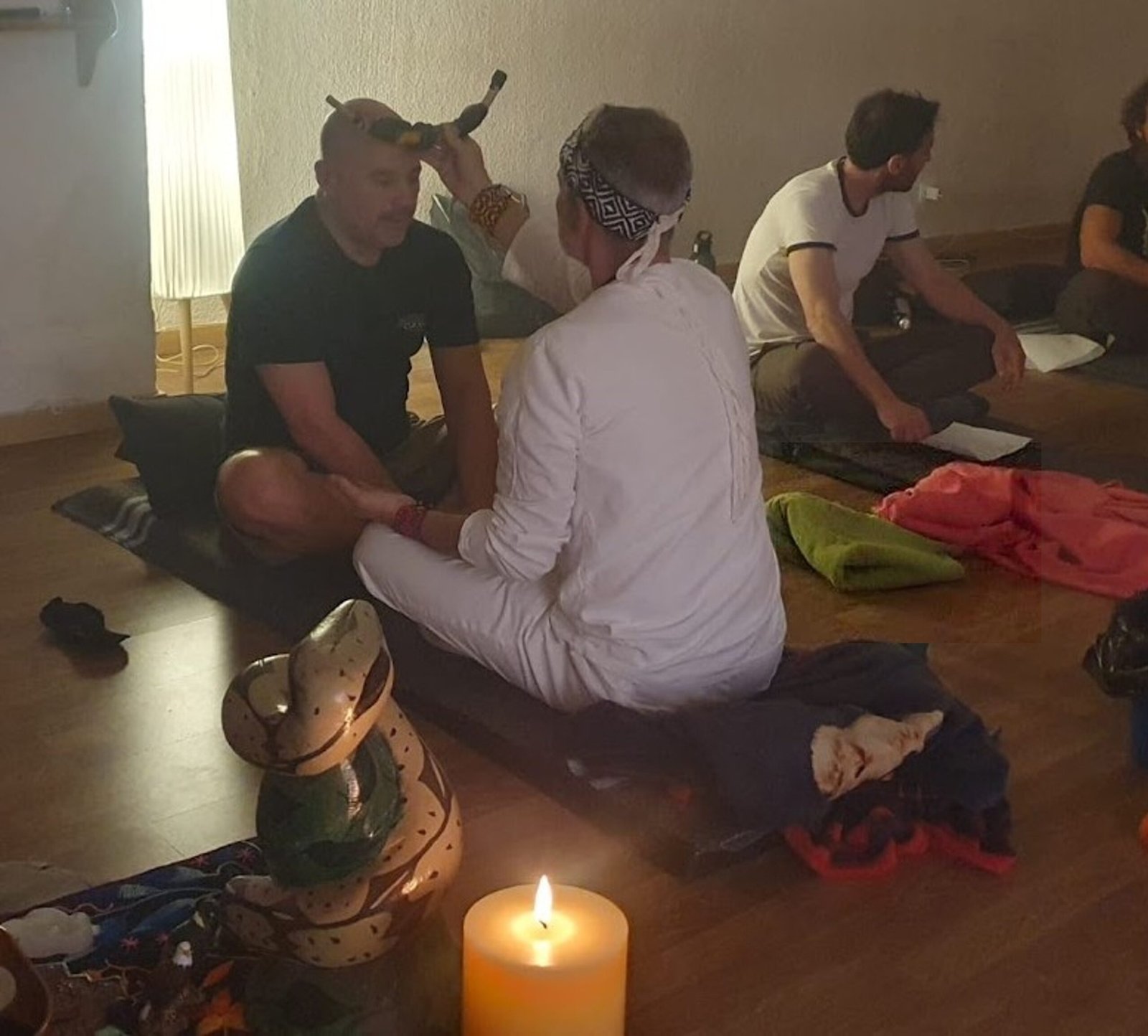
Saturday: a light breakfast, bodywork and breathing in the morning, sananga and rapé at midday — two traditional Amazonian medicines, both optional, which we explain before offering them — a light lunch, and fasting from mid-afternoon. The afternoon is for silence or time in nature: your nervous system needs to settle before the next night. The second ceremony is that night.
Sunday: breakfast, a group integration circle, a closing lunch and guidance for the days ahead. You leave on Sunday afternoon. You can work on Monday — though if you can keep that day free, even better.
There’s something that doesn’t fit into a timetable and happens almost every time: you arrived not knowing anyone, and you leave with a handful of people who have seen you as almost nobody else ever does. That doesn’t have to turn into friendship. But while the weekend lasts, it carries you more than you’d think from the outside.
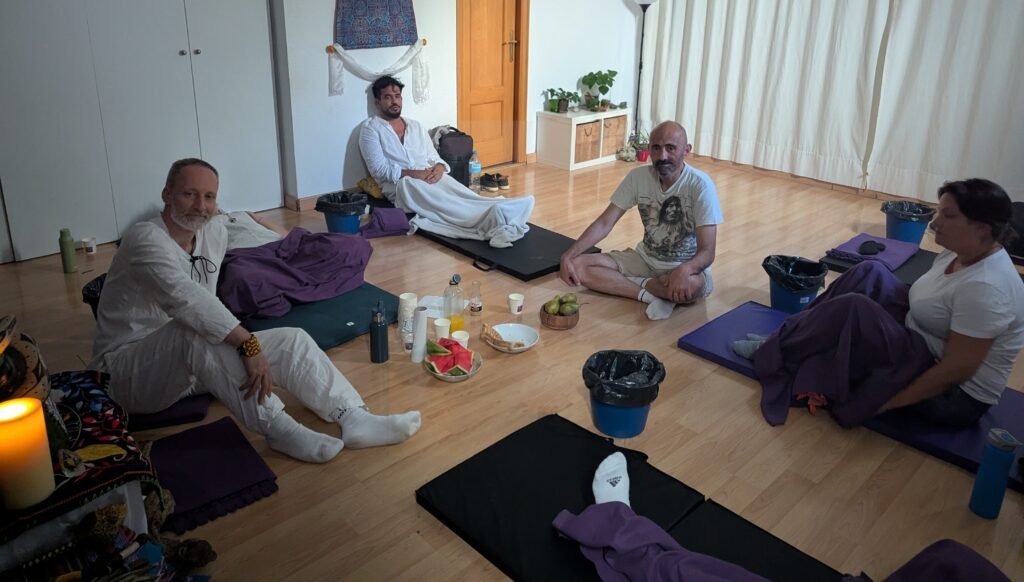
Why two nights. Part of the first night goes to dealing with the unknown: you don’t know what the beginning feels like, you don’t know the room or the people, and part of you is negotiating with the experience instead of entering it. By the second night you know what it’s like. The beginning doesn’t frighten you, you stop resisting, and what came up on the first night has somewhere to land. Many people describe the second night as deeper for that reason: by then, you’re different.
It doesn’t always go that way. Some people have their important night first and a quieter second one. But two nights make it much more likely that you’ll reach what you came for.
Already living in Madrid? The one-day ceremony
If you live in Spain or are already in Madrid, there’s also a one-day ceremony: a single daytime ceremony, no overnight stay, no need to rearrange your whole week. Many people find it a good way to begin: you get to know the medicine, you get to know me, and you see how it sits with you, with the same care as always — the video call beforehand, the medical questionnaire, the preparation and a co-facilitator present throughout the ceremony.
It takes place in a private space in central Madrid, near Atocha, easy to reach by public transport. The same quality of care as in the Sierra, in a different setting.
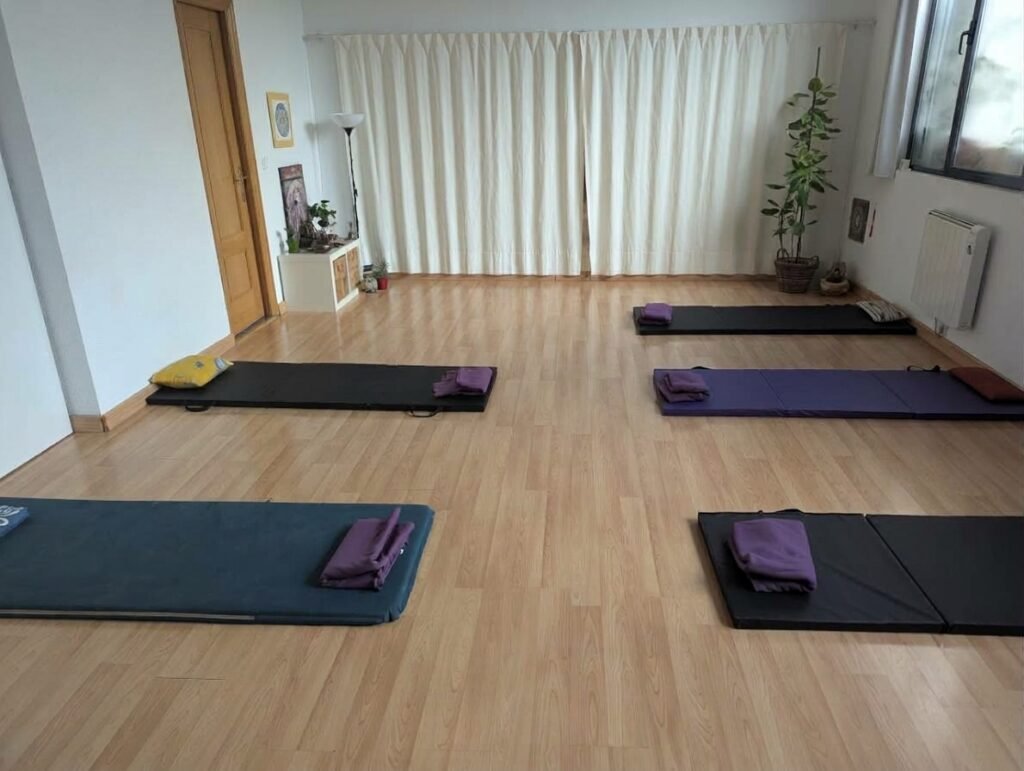
10:30 — Arrival. Welcome and opening of the space. Then the energetic cleansing, which is already part of the ceremony, and rapé if you’d like it (it’s optional and we explain it beforehand).
Around 11:30 — First cup. The ceremony lasts until about 16:30.
Around 16:30 — Closing. A simple snack and fruit, followed by the integration circle.
Until 19:30 — Quiet time. We rest and talk. If you need more time, you can stay longer: nobody leaves until they’re stable and looked after. Times are approximate.
The days after: I message you every day on WhatsApp to see how you are. And if something is hard to make sense of, we talk on the phone as often as needed.
What happens during the ceremony
You come into the room. You have your own place: a mattress, blankets, a cushion and a bucket. The bucket is there because it gets used, and talking about it plainly is part of what makes this work.
The space is opened with smoke. Then you come forward, drink and go back to your place. For the first half hour or so, almost nothing happens: the room is silent and you’re waiting. That wait is often the most uncomfortable moment of the night.
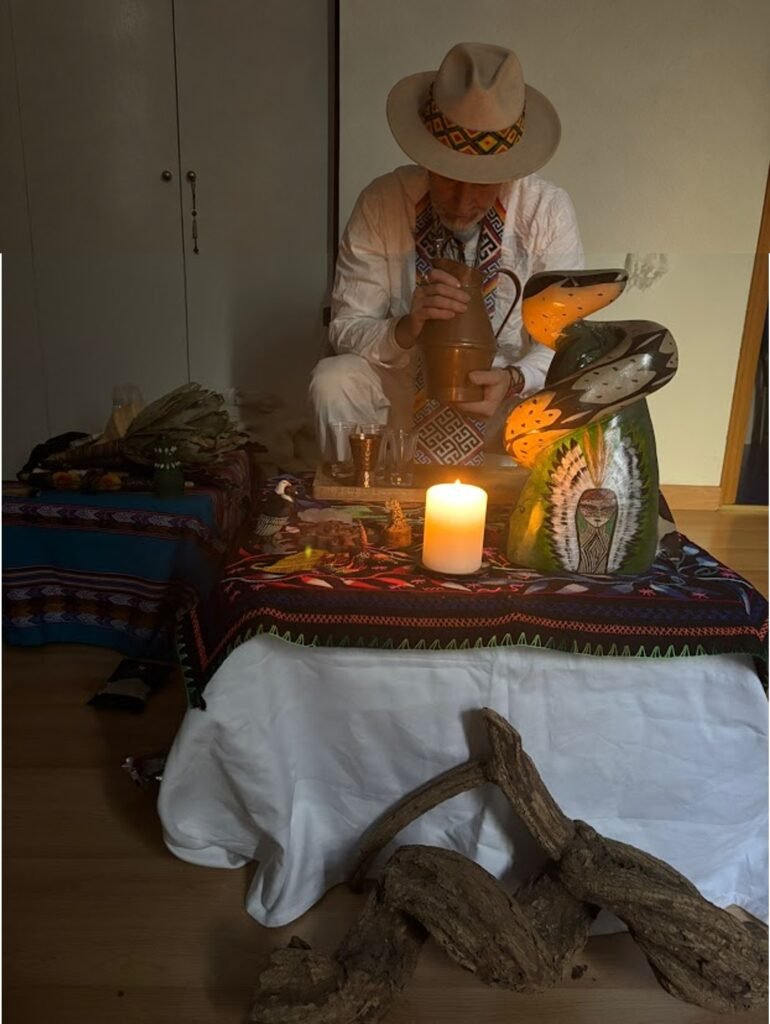
Then, somewhere between thirty and sixty minutes in, it starts to rise. First in the body: warmth, tingling, often nausea. And the music begins.
What happens from there varies enormously from one person to another, and from one night to another in the same person.
You’re never alone. Someone is paying attention at every moment, moving around the room. If you need the bathroom, we go with you. If you get frightened, we sit with you. You don’t have to get through anything on your own: asking for help doesn’t interrupt anything or bother anyone.
Towards the end the music softens, the intensity drops, and the circle is closed. On the weekend retreat that happens between two and three in the morning: afterwards you can sleep, stay a while in silence, or step outside to look at the sky, which in the Sierra is reason enough not to go to sleep just yet. After the one-day ceremony, you don’t leave until you’re stable and looked after.
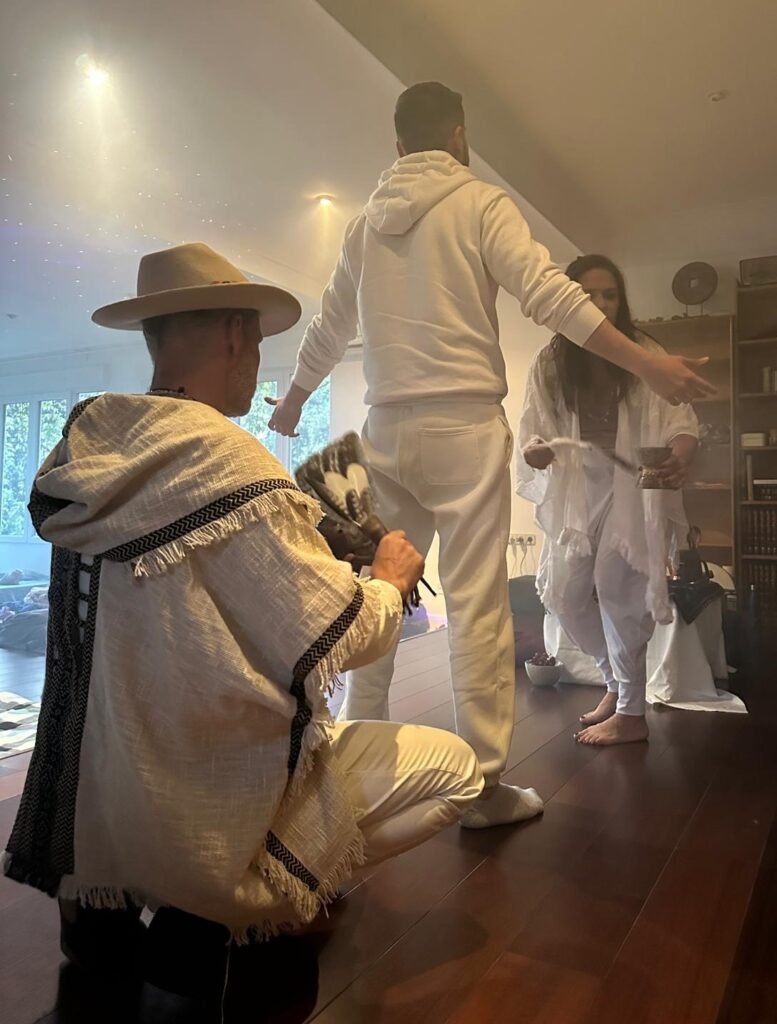
The morning after
You wake up feeling strange. Tired in a way that’s unlike ordinary tiredness and, at the same time, somehow washed clean. Some people wake up crying without being sad. Some are hungry for the first time in weeks. Some don’t want to talk to anyone until mid-morning, and that’s fine: nobody will ask you to share anything before you’re ready.
What almost nobody has at that hour is a tidy conclusion. Conclusions, when they come, tend to come later — in the following week, on the follow-up call, sometimes a month later on the drive to work.
A note on the purge: vomiting happens in quite a few ceremonies, and some traditions regard it as a cleansing. It doesn’t happen every time or to everyone. It isn’t forced. You don’t need to purge to benefit from the experience. I mention it because many people fear it, and it’s better to know beforehand than to be surprised by it.
Phase 3: The Alma Fénix Integration Programme — 30 days
This is what sets Alma Fénix apart from most facilitators. The ceremony opens doors. Integration is walking through them.
The first weeks after a retreat are often the most intense — the material that came up is still being processed, what you understood is still finding its place, and everyday life pushes in the opposite direction. For us, accompanying that period is as much part of the work as the ceremony itself.
Over 30 days, the Alma Fénix Integration Programme includes one integration session straight after the retreat and two deeper sessions within the first four weeks. In total: 3 structured follow-up sessions, with me, in English, German or French. If you live outside Madrid, we do them by video call, so it works wherever home is. It’s all included in the price of the weekend retreat — not an extra.
We don’t send you home with whatever happened and a “see you around”. We’re with you while what you saw in the ceremony starts to show up in your life.
The 30-day Integration Programme is included in the weekend retreat. With the one-day ceremony the follow-up is shorter: a week of daily messages and, if something comes up that’s hard to make sense of, personal calls. Details below.
Questions before you decide?
Write to me and I’ll answer them. If it makes sense to go ahead, the next step is a free 30-minute video call, with no commitment.
No two nights are the same
There’s no such thing as a typical ceremony. I’ve been sitting with the medicine for many years and I still get a little nervous before every cup, wondering where it will take me this time. That’s not a bad sign: you genuinely can’t know. Nobody reaches a point where they have it under control.
Two people who drink the same brew, on the same night, in the same room, can have experiences that have nothing in common. It can be the most luminous thing you’ve ever experienced. It can be one of the hardest nights of your life. Sometimes both on the same night.
I want to stay with the second possibility for a moment, because it’s the one people talk about least.
A difficult night isn’t a “bad trip”. Often it’s exactly the part that helps: the fear, sadness or anger you’ve been avoiding for years shows up to be felt, and feeling it is precisely what you haven’t been able to do until now. It isn’t always like that. Some hard nights are just hard, and not everything that hurts means something. But here, difficulty isn’t treated as a failure or as something to avoid: it’s treated as part of the work. And at no point are you left alone in it.
That said, and so as not to leave you with a false picture: most nights aren’t like that. I’m telling you this in detail because hardly anyone else will, and because I want you to arrive knowing what you’re getting into — not because suffering is guaranteed. It isn’t.
There are gentle nights. Some people spend half the ceremony crying with gratitude without quite knowing why. Some laugh to themselves in the dark. Some have no revelation at all and simply listen to the music for hours, and in the morning say they hadn’t rested like that in years. All of that is Ayahuasca too, and it’s considerably more common than the difficult nights.
This isn’t a guarantee, and it isn’t what happens to everyone. At the start I gave you a glimpse of some of these things; here, in more detail, is what I’ve seen — in myself and in the people I’ve accompanied — on the occasions when it did happen:
- Seeing your own pattern from the outside. For years you’ve been looking at your life through a lens. One night, without looking for it, you stop looking through it and see the lens itself — as if you stopped looking through the viewfinder and suddenly saw yourself holding the camera.
- From head to body. This is how it happened to me: there was something I wanted to change, which I understood perfectly well in my head and yet couldn’t seem to shift inside me. One night, without my asking, that change stopped being an idea and started to be felt in my body. The problem was still the same. But it no longer lived only in my head.
- Uncomfortable clarity. It doesn’t arrive as a plan. It arrives as something obvious you’ve spent years avoiding: yes to this, no to that, and the thing you’ve been putting off for ten years — and you know it.
- Seeing someone without all the layers. Your mother, your partner, your child, someone who died. Sometimes they appear without the years of grievances and defences that have settled on top, and for a moment you see them as if for the first time.
- Feeling that you’re not alone in the universe, even if it’s the only night of the year you truly feel it.
And there are nights when none of this happens. You lie down, you wait, your body feels strange, and it’s over. It happens to people who did everything right, and it doesn’t mean you’ve failed — nor does it mean nothing happened. Sometimes what moves isn’t noticeable that same night.
There’s something I can’t promise you, but I think you have a right to know it: some of the most joyful moments of my life, and the moments of deepest connection with something larger than me, have happened inside an Ayahuasca ceremony. I’m not telling you this because it will happen to you; I can’t know that. I’m telling you because it would be dishonest to describe the hard part in detail and keep quiet about this one.
What I can guarantee isn’t the outcome. It’s how you’ll be looked after while it happens, whatever it turns out to be.
There’s no “right” experience. Every process is different.
Safety, and who shouldn’t take part
Ayahuasca is a powerful medicine. It has real contraindications — some absolute, some relative — and it isn’t right for everyone at every moment.
If there’s one thing we’re proud of, it’s this: we say no when no is the right answer. A facilitator who accepts everyone isn’t protecting anyone.
I’ve also seen what happens when this is done badly. People leaving ceremonies with no support at all, with things opened up that they didn’t know how to process. People who took Ayahuasca with medication they didn’t declare because nobody asked them the right questions. People at retreats of 40 where nobody had time for them when they needed it.
The Alma Fénix safety protocol — what we check before every ceremony:
- A complete medical questionnaire and an individual review of your mental health
- A thorough review of your current medication against ICEERS criteria
- Checks for drug interactions (especially SSRIs, MAOIs, antipsychotics and lithium)
- Cardiovascular screening — high blood pressure, arrhythmias, heart conditions
- A complete emergency first-aid kit at the ceremony space
- An established protocol for contacting local medical services
- Vehicle access to the space at all times
- A maximum ratio of 1 facilitator to 5 participants
- Screening, ceremony and integration in a language you speak, with no translator in between
No translators — and that’s a safety feature
Many Ayahuasca retreats, especially in South America, work with a translator between participants and facilitators. There are two moments when that matters most.
In the screening. When you tell me about your medication, your mental-health history and what’s going on in your life, details matter. A dose, a diagnosis, a half-sentence about how the last few months have been: these are exactly the things that get lost in translation.
In the ceremony. When something difficult comes up — fear, grief, a memory, or just an emotion you can’t place — you want the person beside you to understand what you’re saying, in your own words, without someone in between. And you want to understand what they say back.
I speak German (native), English (fluent) and French (conversational), as well as Spanish. I do the screening call, lead the ceremony and run the integration sessions myself. My co-facilitators speak Spanish and basic English, so if you need to talk during the ceremony, I come to you.
That’s why I only accept participants I can communicate with easily. If we don’t share a language well enough to talk about your health, and about what’s happening to you at three in the morning, I’ll tell you on the first call.
Is this for you?
| Possibly yes, if… | Possibly not now, if… |
|---|---|
| For a while now, you’ve been stuck with something you understand perfectly but can’t change. | You take antidepressant medication and haven’t yet discussed it with us or with your doctor. |
| You’re looking for a connection or a meaning you can’t find in other ways, even if it’s hard to say out loud. | There’s a diagnosis or family history of psychosis, schizophrenia or bipolar disorder. |
| You want to look at how you’re living, not just how you feel. | You’re going through an acute crisis and what you need is stable support, not an intense experience. |
| There’s someone in your life, living or dead, with whom something is unresolved. | You’re looking for a strong experience and little more: to try something intense and talk about it. That’s legitimate, but it isn’t what we do here. |
| You’re willing to have a difficult night if something comes out of it. | You expect one night to resolve what needs months of work. |
| You accept that nobody can guarantee you an outcome, and you still want to do it. | You can’t or don’t want to do the preparation beforehand. |
| You understand that the real work starts on Monday. | You need to do it now, this week, whatever it takes. |
The right-hand column isn’t a list of permanent exclusions. Almost all of it means “not now”. Some people come back a year later, at a different moment in their life, and then it’s a yes.
The most important absolute contraindications are: antidepressant medication without having completed the washout period (at least 4 weeks after the last dose for most antidepressants, 5 weeks for clomipramine, imipramine and vortioxetine, and 7 weeks for fluoxetine — not the 2 days you’ll find online), a history of psychosis or schizophrenia, pregnancy, unstabilised bipolar disorder, and uncontrolled cardiovascular conditions.
Never stop or reduce your medication on your own in order to take part. Any change has to be decided with the doctor who prescribed it.
If you take medication or have doubts about your medical situation, we work through it together during screening — including coordinating with your doctor or psychiatrist if necessary. The aim isn’t to exclude you, but to make sure that when you take part, it’s in genuinely safe conditions.
Why an Ayahuasca retreat in Spain, and not in Peru or Brazil?
It’s what almost everyone asks, and it deserves a clear answer.
There are excellent retreats in Peru and Brazil. If you have three weeks free, want to experience the Amazon rainforest and are looking for a long, deep immersion, going there makes complete sense. I’m not going to tell you otherwise.
But most people who come to Alma Fénix don’t fit that profile. They have jobs, families, responsibilities. They have a weekend, or a day. And they have something even more important: they don’t want what happens in the ceremony to be left hanging when they’re back home on Monday.
That’s what a small retreat near Madrid can offer that a retreat in Peru structurally can’t: real continuity. The person who was with you in the ceremony is the person you work with in integration. There’s no break. You don’t go home alone with an experience to process and no context.
And then there’s something simpler: many people would rather have their first experience with the medicine closer to home. If you live in Spain or elsewhere in Europe, Madrid is a short flight away, not a long-haul journey to another continent. Close, and with someone you’ve already spoken to before you arrive. That counts too.
If you’re weighing Ayahuasca retreats in Europe against a trip to South America, these are the real differences:
| Retreat in Peru or Brazil | Alma Fénix — Madrid, Spain |
|---|---|
| 12–21 days including travel | A weekend (Friday to Sunday), or a single day |
| A long-haul flight | A short flight from most of Europe |
| You go home and process it alone | Integration with the same facilitator |
| Groups of 20–40 people (common) | A maximum of 9 participants, with personal attention throughout the ceremony |
| Minimal or no integration | Follow-up included (30 days with the weekend retreat) |
| Rotating facilitators | The same two facilitators throughout |
| The real Amazon rainforest | The Sierra de Madrid, or central Madrid |
They’re not mutually exclusive. Some people start close to home and go to the Amazon later. That’s your call.
Price and dates
Weekend retreat (Sierra de Madrid): €450 per person, all inclusive.
Includes: accommodation on Friday and Saturday night, all meals over the weekend, two Ayahuasca ceremonies, an integration circle and the 30-day Alma Fénix Integration Programme.
On its own, the integration programme would cost €150. We include it because we believe a ceremony without integration is only half done. It makes no sense to us to offer one without the other.
Single night (Sierra de Madrid): €250 per person. One ceremony, one night’s accommodation and the corresponding meals. Includes the 30-day Integration Programme.
One-day ceremony (central Madrid, near Atocha): €150 per person. One ceremony from about 10:30 to 19:30, no accommodation. Includes the ceremony, a simple snack and fruit, the integration circle, a follow-up message every day for the following week and, if something comes up that’s hard to make sense of, one or more personal calls. No other meals are included.
About follow-up in each format: the 30-day Integration Programme (three structured sessions) is included in the weekend retreat and in the single night. With the one-day ceremony the follow-up afterwards is shorter: I message you every day for the following week and, if something comes up that’s hard to make sense of, we talk on the phone as often as needed. At €150 I can’t offer you the same as at €450, and I don’t want to pretend I can.
Upcoming dates:
Weekend retreat (Sierra de Madrid): planned for February 2027, exact dates to be confirmed — message me and I’ll let you know.
One-day ceremony (Madrid): message me and I’ll tell you the next date.
Cancellation policy: to book your place I ask for a €50 deposit. If you cancel at least two weeks in advance, I’ll refund it or keep it for another date, whichever you prefer. Otherwise it isn’t refundable. The rest is paid on the day you arrive.
Limited places, so I can look after each person: a maximum of 9 per ceremony or retreat.
Travelling to the retreat from abroad
Where. The weekend retreat is held in the Sierra de Madrid, about an hour from the city. If you’re flying in, you’ll land at Madrid-Barajas airport.
Getting to the house. You don’t need a car: I organise car-sharing from Madrid with the other participants.
When to fly. Arrival at the house is between 17:00 and 19:00 on Friday, so aim to be in Madrid by early afternoon, or arrive the day before. The retreat ends on Sunday afternoon, after the closing lunch. Book your flight home for Sunday evening at the earliest. Monday is better, so you don’t go straight from the closing circle to an airport; an extra night in Madrid is worth considering.
The preparation diet. It starts at least 3 days before the retreat, ideally 7, so plan your travel days around it. We go through it together on the call.
Language. I lead the ceremony in English and Spanish. Your preparation call and integration sessions are with me, in English, German or French.
After you fly home. The integration sessions are by video call, so the follow-up doesn’t depend on where you live.
Frequently asked questions
How much does an Ayahuasca retreat in Spain cost?
The weekend retreat in the Sierra de Madrid costs €450 per person, all inclusive: accommodation, meals, both ceremonies and the 30-day Integration Programme (3 follow-up sessions). The one-day ceremony in Madrid costs €150 per person and includes follow-up for the following week. Most retreats in Spain and Europe charge between €400 and €750 for the ceremonies alone, without follow-up afterwards. At Alma Fénix, follow-up is included in every format, because offering a ceremony without it makes no sense to us.
Do I need to speak Spanish?
No. I lead the ceremony in English and Spanish, and your preparation call and integration sessions are with me, in English, German or French. There’s no translator in between. Groups can be mixed, so you’ll hear some Spanish in the room. My co-facilitators speak Spanish and basic English; I’m in the room throughout the ceremony.
Can I take part if I’m on antidepressants?
It depends on the type and on how long it has been since your last dose. Combining Ayahuasca with antidepressants that act on serotonin (SSRIs, SNRIs) can cause serotonin syndrome, a serious medical reaction. The waiting time I ask for is at least 4 weeks after the last dose for most antidepressants, 5 weeks for clomipramine, imipramine and vortioxetine, and 7 weeks for fluoxetine. You’ll find claims online of 2–3 days: that isn’t medically correct, and it’s dangerous. Never stop or reduce your medication on your own in order to take part; any change has to be decided with the doctor who prescribed it. If you take antidepressants, tell me on the first call: we look at it together, and with your psychiatrist if needed. It may be possible, with the right preparation time.
What’s the difference between an Ayahuasca retreat in Spain and one in Peru?
The main differences are logistics and follow-up. A retreat in Peru usually takes 12–21 days including travel, with groups of 20–40 people and little or no integration afterwards. A retreat near Madrid like the ones we offer at Alma Fénix is a weekend (Friday to Sunday) or a single day, with groups of no more than 9, follow-up afterwards (30 days with the weekend retreat) and the same facilitator from start to finish. That doesn’t make one better than the other — it depends on what you’re looking for. If you have three weeks free and want the full Amazonian experience, Peru makes sense. If you have a weekend and want real continuity in the process, Spain may be the more sensible option.
It’s my first time with psychedelics. Is this for me?
Many people who come to our retreats have no previous experience with psychedelics. Our preparation is designed specifically to give you the tools you need — how to navigate difficult states, what to expect physically, how to find your bearings when the experience intensifies. The first time can be especially powerful precisely because there are no earlier patterns getting in the way. What matters isn’t previous experience but willingness to do the work. That said, whether this is for you, and whether now is the time, is something only you can answer.
Can I come alone, or do I need to come with someone?
Most participants come alone. In a small group that has shared a ceremony like this, very strong bonds often form between people who didn’t know each other that morning — even more so on the weekend retreat, with two nights. If you come with a partner or a friend, each of you goes through screening separately, and it’s important that each of you can have your own process without looking after the other.
What if I don’t feel anything in the ceremony?
It happens, though it’s uncommon. Sometimes it’s metabolic. Sometimes it’s recent medication. Sometimes it’s psychological resistance, which is worth exploring in itself. It’s never a failure — it’s information. On the weekend retreat, which has two ceremonies, if the first night is much milder than expected, we adjust the preparation and approach the second night in a more targeted way. After a one-day ceremony, we talk about it during the following week’s follow-up.
Is it safe for women coming alone?
Yes. We never hold a ceremony without a female co-facilitator present. That’s not a matter of circumstance; it’s a principle of how we work. Her presence creates a safer, more contained space for all participants, and especially for women who come alone. We have clear protocols on boundaries and personal space. Zero tolerance for any inappropriate behaviour.
What happens after the ceremony, on the same day?
The main effects fade gradually towards the end of the ceremony. Nobody is left alone. On the weekend retreat you sleep in the rooms of the house, and we’re still there. After the one-day ceremony there’s a snack, the integration circle and quiet time until about 19:30; we make sure everyone leaves accompanied or fully stable before we part, and anyone who needs more time can stay. Residual effects — greater sensitivity, emotional processing, vivid dreams — can continue for several days.
How much time off work do I need?
The weekend retreat runs from Friday afternoon to Sunday afternoon; if you’re travelling from abroad, add your travel days (see Travelling from abroad). The one-day ceremony takes one day (about 10:30 to 19:30), with no overnight stay. On the day after the ceremony (or the Monday, after the retreat) we recommend avoiding demanding commitments if you can — though most people work without any problem. The first days after a ceremony tend to have a different quality, and if you can protect them a little, all the better. But it isn’t essential.
What makes Alma Fénix different from other facilitators in Spain?
I don’t want to knock anyone else’s work. What sets us apart is the combination: rigorous safety screening; follow-up included after the ceremony — 30 structured days with the weekend retreat, a week with the one-day ceremony (many offer no real follow-up); co-facilitation by two people with complementary profiles; personal attention throughout the ceremony (groups of no more than 9, and we go round the room asking how each person is); and real continuity afterwards, wherever you live. And also, I think, honesty about the limits of what we are — we’re not shamans, we’re not clinical therapists, we don’t promise miracles. We’re a serious bridge between the medicine and your life.
Is Ayahuasca legal in Spain?
It’s a fair question, and it deserves a straight answer.
Banisteriopsis caapi and Psychotria viridis — the plants that make up Ayahuasca — are not on Spain’s lists of controlled substances. What is controlled is DMT as an isolated compound. Several court cases in Spain have set important precedents for ceremonial use in a private setting.
We work in a private, ceremonial setting, with small groups, safety screening and no mass advertising. I’m a member of the Plantaforma para la Defensa de la Ayahuasca, a Spanish association that works actively to defend responsible ceremonial use.
If you’re coming from another country: the law where you live may be very different, and Ayahuasca is prohibited in many European countries. Never carry Ayahuasca, or the plants it’s made from, across a border.
I’m not a lawyer and this isn’t legal advice. If you have specific questions about the legal situation, we can talk about them during screening.
Is this your moment?
If you’ve read this far, something in you already has an answer. Maybe it’s a clear yes. Maybe it’s “I want to know more before deciding”. Maybe it’s “I’m scared, but something tells me this is what I need”. All three are valid. And if you don’t know yet, there’s no hurry. We’ll still be here when you do.
The screening call isn’t a commitment — it’s a conversation. Thirty minutes. Free. No pressure.
By the end of that call you’ll know what the process would look like and what the next step is. If it makes sense to go ahead, I send you the medical questionnaire, and once I’ve reviewed it, I confirm whether you can take part safely. And if it isn’t the right moment, or we’re not the right option for you, I’ll tell you directly — including what alternatives you have.
The first step is a message
I reply myself · No commitment · Fully confidential
I usually reply within 24–48 hours.
Alma Fénix · Madrid, Spain · +34 670 92 24 46
Legal pages (in Spanish): Privacy policy · Cookie policy · Legal disclaimer · Terms of use