
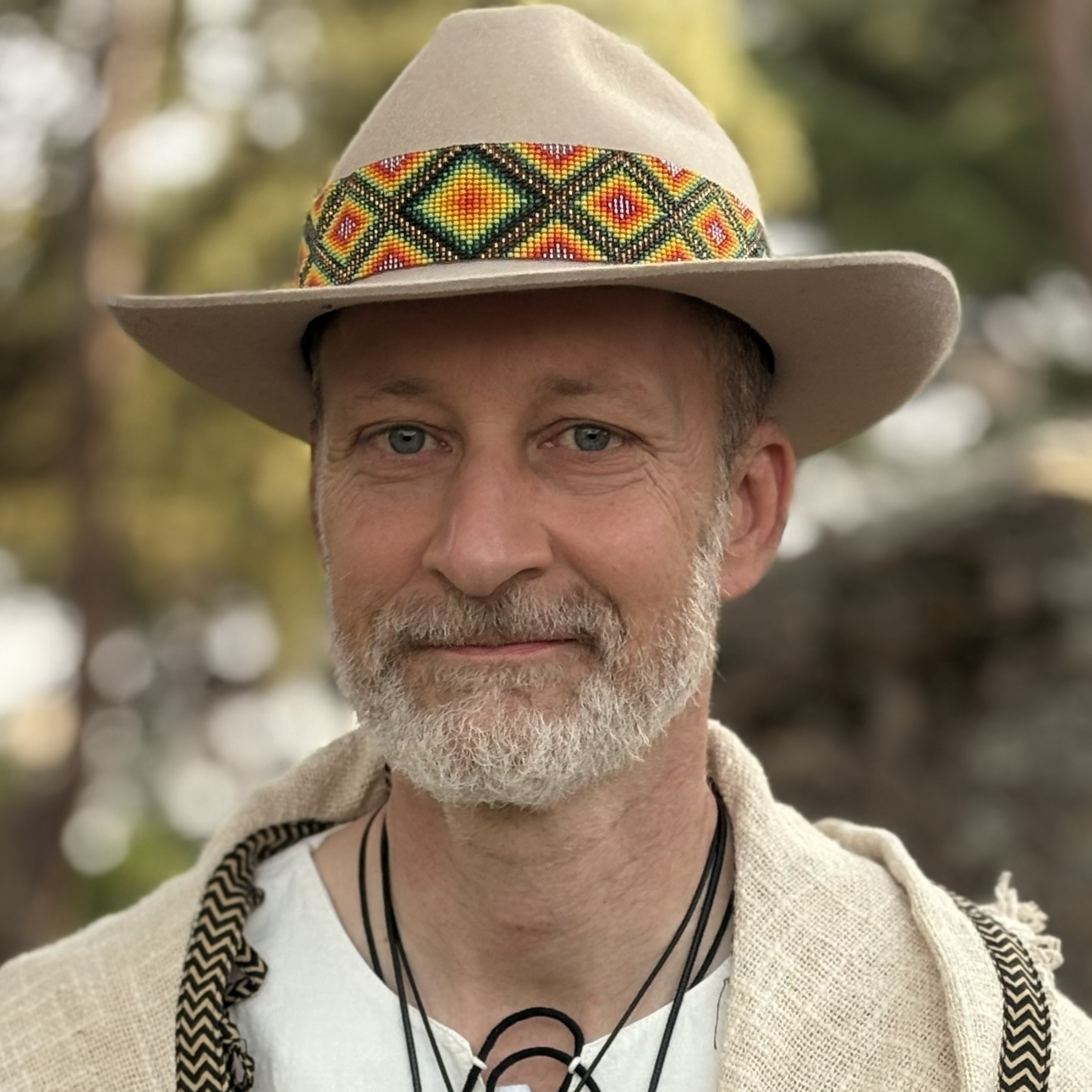
Friedrich «Fede» Funkel
Building a bridge between scientific evidence and the wisdom of the jungle.
Training & Credentials
- MSc in Cognitive Neuroscience and Biopsychology — Universitat Autònoma de Barcelona
- MSc in Applied Positive Psychology — Universitat Jaume I
- MSc in Transpersonal Therapy — Instituto Marly Kuenerz
- AyaSafety: Increasing Safety in Ayahuasca Sessions — ICEERS
- Psychedelic-Assisted Therapy Training — Asociación Psicodélica de Argentina
- Apprentice in the Huni Kuin tradition (Brazil)
On this page I tell you who I am, why I created Alma Fénix and what I commit to, so you know what training stands behind the information on this site, and what level of rigour and support you can expect from me.
My Story: The Why
It was 2008. I was on a sabbatical year, travelling through Colombia, Cuba and Brazil with no real agenda, and certainly no plan that had anything to do with this. Some Colombians invited me to go looking for magic mushrooms in the countryside near Popayán. More out of curiosity than anything else, I said yes.
What I experienced was one of the deepest moments of connection with nature of my life. I didn’t «wake up enlightened», and there was no instant revelation. A door simply opened: a curiosity about these substances and their potential that I would keep following for the next fifteen years.
Years later, I came to Ayahuasca out of need rather than curiosity. I had been through a period of my life that I won’t go into here, out of respect for the people involved. What I can say is that it left me completely numb inside. And I mean that literally, not as a metaphor: I felt nothing. No joy, no pain, not even the sense of smell. Just an inner silence that was not peace.
The medicine gave me back something I didn’t know I had lost: my connection with myself. Not all at once, and not dramatically, but little by little, ceremony after ceremony, as if I were thawing out layer by layer.
Some years after that, life brought me another loss, the hardest I have had to face so far. It brought me to my knees. And once again, it was Ayahuasca, together with a great deal of inner work, that helped me keep going and come out the other side.
That is what stands behind Alma Fénix. Not an abstract calling or an academic interest, but a very concrete and very personal conviction: access to rigorous information and serious support around these medicines can make a difference. Literally.
My Approach: The Bridge
Before I describe my approach, I want to say something that goes beyond courtesy. Everything I know about these medicines and traditions comes, ultimately, from the peoples who have safeguarded them for centuries: the Huni Kuin, the Shuar, the Shipibo, the Kamentsa and many others. I am grateful to the Indigenous peoples who preserved this knowledge while the Western world persecuted them for it; to the teachers who chose to share it with someone like me; and to the Huni Kuin community, who showed me that working with sacred plants cannot be separated from a way of living.
These traditions are not history. They are living practices, sustained by real communities, and we need to keep reminding ourselves where this knowledge comes from, who created it and who holds real authority over it: the Indigenous peoples who work with Ayahuasca. I am a grateful apprentice, and keeping that in mind is the compass that guides my work.
I see two opposite mistakes made over and over in this field.
The first is reducing Ayahuasca to neurochemistry: explaining everything through 5-HT2A receptors, the Default Mode Network and neuroplasticity, as if an experience capable of changing a person’s life were just «serotonin bouncing around». Science is an indispensable tool, but it doesn’t explain everything.
The second is the reverse: dismissing any scientific framework as «limited Western thinking» and wrapping everything in an inaccessible mysticism. That leaves people with no practical information about safety, contraindications or how to integrate what they have experienced.
My position is that we need both worlds. I don’t reject science in the name of spirituality, or spirituality in the name of science. I use them together, because each lights up what the other leaves in shadow.
In practice, this means: when I write about a drug interaction, I explain the exact pharmacological mechanism, and also the ritual context in which the medicine is used and why that context matters for safety. When I write about integration, I offer both evidence-based psychological tools and the perspective of traditions that have worked with these processes for centuries.
I don’t have definitive answers. The medicine is the teacher. All I can do is create the safest and best-informed conditions possible for the work to happen.
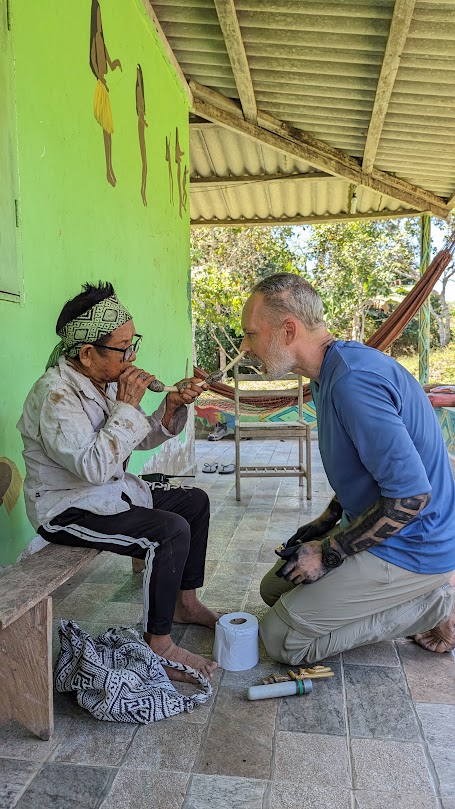
With Pajé Kupi of the Huni Kuin lineage
First-Hand Experience
I have taken part in more than 100 Ayahuasca ceremonies, and ceremonies with other traditional medicines: as a participant, as an observer during my training and, later, as a facilitator.
I know from the inside what it means to sit in ceremony and face whatever comes up. The difficult nights. The lessons that seem impossible to put into words. The struggle to hold on to the changes in everyday life when the following Monday arrives.
I remember several ceremonies in which I kept telling myself: «I want this to end. I want to go home and never do this again.» And yet a few months later, there I was, sitting in another ceremony. If you have had a difficult experience with the medicine and wonder why you still feel there is something there, I understand you completely.
I don’t write about this from theory.
Trained in Two Worlds
I came to neuroscience to understand what I had lived in the jungle, not the other way around. That order matters: the experience came first, then the need to understand it rigorously.
Science Gives Me…
The tools to keep you safe. I can tell a solid study from one whose headline exaggerates, and put that difference into language you can follow.
Tradition Gives Me…
The context that studies don’t measure. Years of learning with Huni Kuin and Shuar communities taught me that these practices hold an intelligence that predates any paper.
What I Am (and What I Am Not)
I am an educator and communicator. My main goal is for you to have access to rigorous information about plant medicine in Spanish, without having to read studies in English or wade through academic jargon.
I am a bridge. Between scientific research and traditional practice. Between what the studies say and what it means in the real life of someone considering taking part in a ceremony.
I am a facilitator. I organize Ayahuasca retreats with small groups in Madrid (Spain), always putting safety and proper preparation first.
I am not a doctor. I can’t prescribe treatments or give individual medical advice. For medical questions, I will refer you to the appropriate professionals.
I am not a shaman or healer. What I have learned from ancestral traditions, I learned as a respectful student, not as a lineage holder. That distinction matters.
I am not a guru. I don’t have definitive answers. The medicine is the teacher; I only create the conditions.
Facilitating Ceremonies
My path as a facilitator began with years of deliberate preparation. Before guiding my first ceremony, I took part in more than 100 ceremonies as an apprentice, studying with experienced facilitators, watching how they create and hold a safe space, and learning as much from the extraordinary ceremonies as from those that didn’t go as planned.
I trained in the Shuar (Ecuador) tradition, learning not only the ceremonial protocols but also the cosmological framework that gives them meaning. I learned directly from practitioners of the Huni Kuin (Brazil) tradition, and I have also worked with Colombian taitas.
An important clarification: I am a respectful student of these traditions, not a lineage holder. I don’t present myself as a shaman or healer. I am someone who has learned from teachers who hold that authority, and who uses what they taught me to create safer, better-informed settings.
I work with small groups in Madrid alongside a female co-facilitator, which lets us give every participant personal attention. My approach combines the structure of the traditions I trained in with current ICEERS safety protocols.
Why I Can Be Your Translator
Most of the rigorous research on psychedelics is published in English. The most advanced debates on integration happen in English. And many of the traditions I work with are passed on in Portuguese or in Indigenous languages.
Having lived in Germany, the United States and Spain, and having spent time in communities in Ecuador and Brazil, is more than biography. It means I can reach these sources first-hand and bring you what matters, so you don’t have to rely on partial translations or on intermediaries who don’t know the terrain.
When you read Alma Fénix, you are reading information filtered by someone who has been on both sides: in the jungle and in the lab, in the ceremony and in the library.
A Personal Note
I am 51 years old and I live in Madrid. For years I worked in the corporate world: suit and tie, KPIs, endless meetings. I understand very well the kind of life many of my readers lead, and why they are looking for something different.
Becoming a father has profoundly changed how I think about this work. It matters to me that what I share is responsible, not just interesting or provocative.
This work isn’t a spiritual hobby for me. It is a vocation I take very seriously, backed by years of academic training, years of traditional learning, and the conviction that rigorous information about plant medicine can make the difference between an experience that transforms and one that harms.
Training in Detail
Master’s in Cognitive Neuroscience and Biopsychology
Universitat Autònoma de Barcelona
What this means for you: I can read primary studies, in English and with complex methodology, and explain what they actually say, without oversimplifications that distort the results.
Master’s in Applied Positive Psychology
Universitat Jaume I · Thesis: Resilience in the face of loss and grief
What this means for you: Plant medicine experiences often bring unprocessed losses and old trauma to the surface. My specialisation in resilience lets me support exactly those processes: not only the luminous insights, but also what hurts.
Master’s in Transpersonal Therapy
Instituto Marly Kuenerz
What this means for you: Transpersonal psychology is the most suitable theoretical framework for supporting non-ordinary states of consciousness. This training gives me the tools to accompany people through these experiences, both in preparation and in integration.
AyaSafety: Increasing Safety in Ayahuasca Sessions
ICEERS — International Center for Ethnobotanical Education, Research & Service
What this means for you: The most rigorous safety programme available in Spanish: screening protocols, medical contraindications and emergency management. The safety information on Alma Fénix isn’t opinion; it is grounded in this standard.
Training in Psychedelic-Assisted Therapy
Asociación Psicodélica de Argentina
What this means for you: Training in the therapeutic frameworks used in current clinical trials, such as those run by MAPS, Imperial College and Johns Hopkins. I understand how professional support is structured in a therapeutic setting.
Ancestral Traditional Training
Shuar tradition (Ecuador) · Huni Kuin tradition (Brazil)
What this means for you: The cultural and cosmological context that academic studies don’t capture, drawn from years of direct learning with communities that have worked with these plants for generations.
Affiliations and Transparency
I follow the Plantaforma Code of Ethics in all my facilitation and support work: informed consent, screening for contraindications, respect for the environment and reciprocity with Indigenous peoples.
All medical and safety content on Alma Fénix goes through external review before publication. Transparency is part of my commitment to you.
Questions about safety? The safety section of my retreat page explains how I screen participants and who should not take part.